ROHINKHED
Also Known As: Raunaqabad
A Fortress of History & Legend
⚔️ The Ancient Village
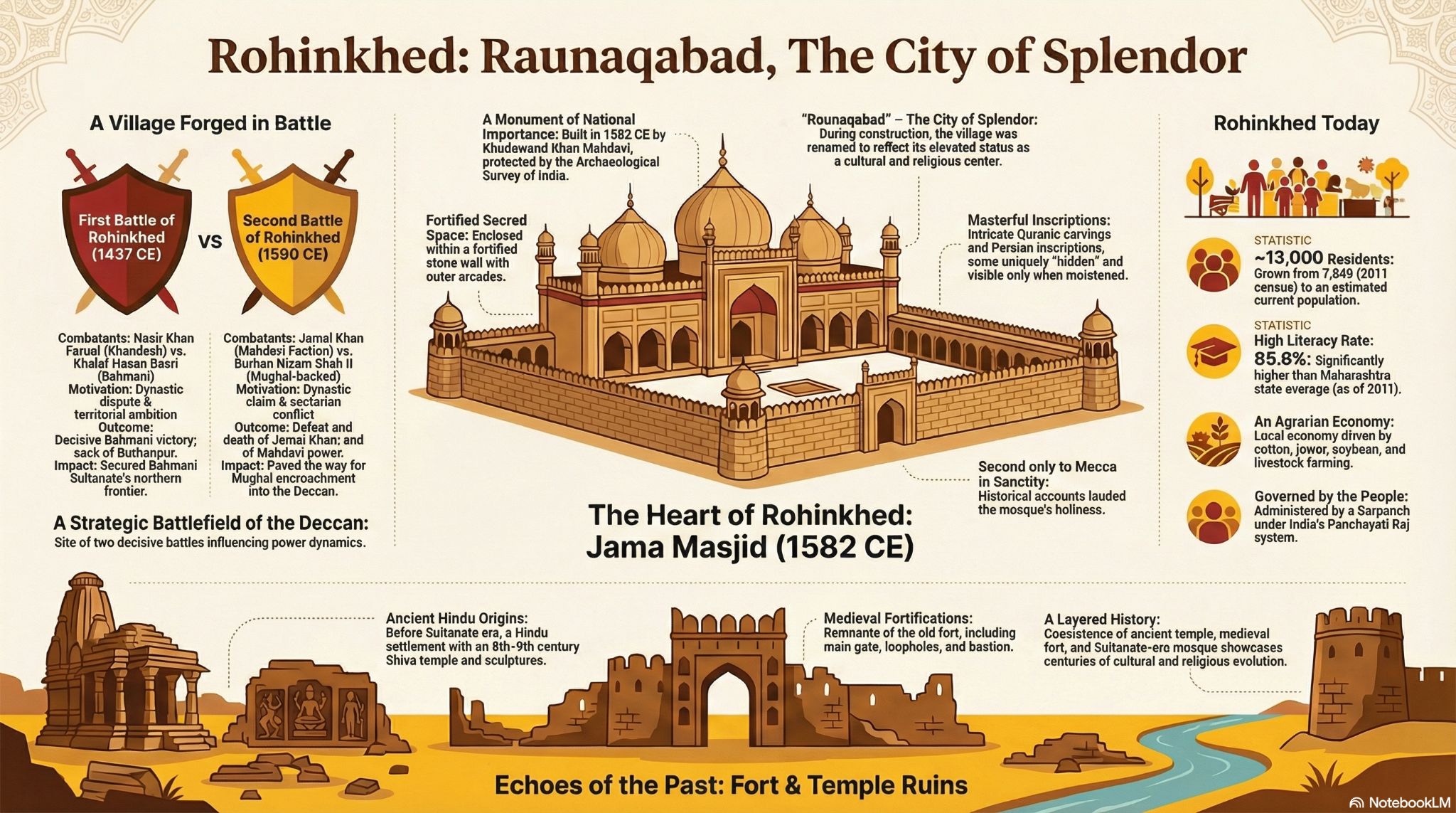
Rohinkhed, known in Nizamshahi period as Raunaqabad , stands as one of Buldhana's most historically significant settlements. Located 23 km from Buldhana city, this ancient fortress village was established between the 8th-9th century, predating even the medieval kingdoms that would later rule these lands. The village has witnessed empires rise and fall, yet maintains its cultural integrity across nearly twelve centuries of continuous habitation.
Glimpse of History
📅 Complete Historical Timeline
From ancient settlements to modern development - Rohinkhed's journey through the centuries:
⏰ Ancient Settlement Founded
Strategic settlement established at the confluence of Nalganga and Jalganga rivers. The village becomes a trading hub for merchants traveling through the Deccan plateau. Evidence of early habitation includes pottery fragments and foundational structures.
⚔️ Battle of Vengeance
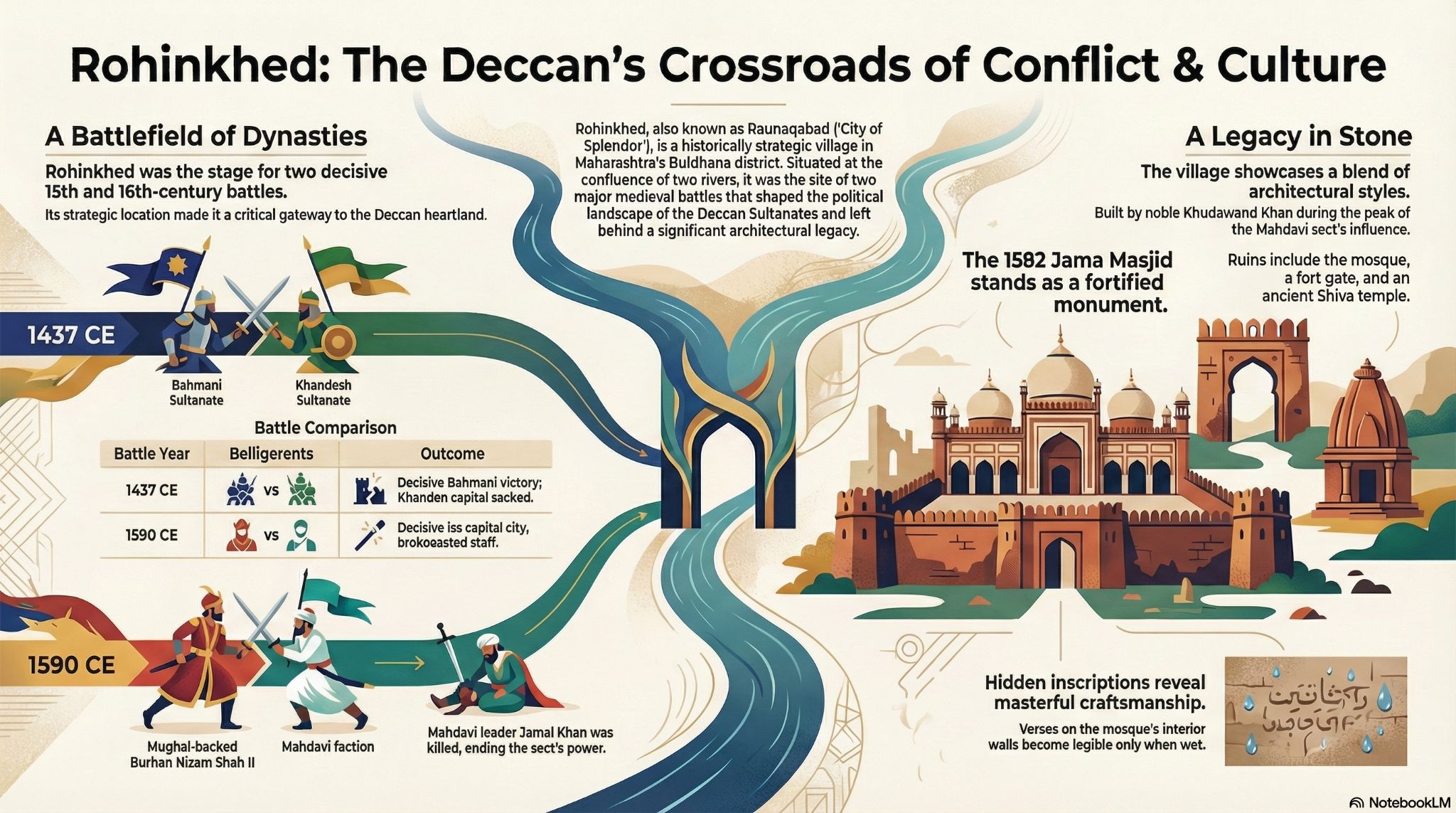
Sultan Nasir Khan Faruqi of Khandesh attacked to avenge his daughter's mistreatment by Bahamani ruler Alauddin Shah. Khalaf Hasan Basri, Governor of Daulatabad, defeated the invading forces at Rohinkhed, marking a pivotal moment in Deccan politics.
🕌 Great Mosque Construction
Khudawand Khan Mahdavi commissioned the construction of the magnificent mosque. This architectural masterpiece features intricate stone carvings, Persian inscriptions, and magical walls that reveal Arabic text when wiped with wet cloth. The structure becomes a symbol of Islamic and Hindu architectural harmony.
🏰 The Throne Dispute Battle
Burhan Nizam Shah and Raja Ali Khan defeated Jamalkhan's forces in a decisive engagement. Jamalkhan's death and the capture of young Ismail Nizam Shah reshape the political landscape of Ahmadnagar Sultanate, with Rohinkhed witnessing this crucial turning point.
👑 Maratha & British Era
The village transitions through Maratha rule and subsequently comes under British colonial administration. The fort gradually deteriorates due to administrative changes and urban expansion, yet the mosque remains a beacon of medieval architecture.
🇮🇳 Indian Independence
Rohinkhed becomes part of independent India and is incorporated into Maharashtra state. The Mosque is recognized as a National Monument of Importance by the Archaeological Survey of India, ensuring its preservation for future generations.
🎓 Education & Development Phase
Multiple schools and educational institutions are established. The village transforms from a purely agrarian settlement to a center of educational development. Infrastructure improvements begin with roads, electricity, and water supply systems.
🌟 Modern Development Era
Contemporary infrastructure expansion with colleges, improved healthcare facilities, and digital connectivity. The village balances preservation of historical heritage with modern development. Literacy rate reaches 85.58%, above Maharashtra average, reflecting educational emphasis.
🕌 Monuments of Glory
The Great Mosque (1582)
Built By: Khudawand Khan Mahdavi
This magnificent structure represents a masterpiece of Islamic medieval architecture. Constructed entirely of stone with intricate carvings, the mosque features:
- Central dome with four minarets at each corner
- Arcaded fortified walls with distinctive gateway
- Persian inscriptions with Quranic verses engraved on stone
- Magical walls - when wiped with wet cloth, red and black Arabic text appears mysteriously
- Ancient fountains and ramparts still intact after 440+ years
- Hemadpanthi architectural style fusion with Islamic design
Status: National Monument of Importance by the Archaeological Survey of India | UNESCO-level historical significance
🏛️ The Ancient Fort
Rohinkhed was once a fully fortified settlement with massive defensive walls strategically positioned between two rivers. Though largely destroyed by urban expansion, visitors can still see:
- Surviving bastions with arched openings
- Ancient fort walls with remnants of ramparts and battlements
- Original stone and brick gateway with gun-fire loopholes from cannons era
- Strategic positioning between Nalganga and Jalganga rivers for defense
- Archaeological evidence of moat systems and fortification networks
⛩️ The Temples
Rohinkhed's spiritual heritage extends across multiple faiths, representing centuries of religious harmony:
- Mahadev Temple - Ancient restored temple with fortified compound and intricately carved pillars
- Maruti Temple - Houses excavated ancient sculptures including Brahma and Ganesha statues from pre-Islamic period
- 12 Veshes & 12 Marothis - Indicating a structured settlement of significant religious importance and organized community
- Multiple Shrines - Dedicated to local deities and historical figures, reflecting agrarian traditions
✨ Unique Heritage Features
12 Centuries
Continuous habitation since 8th-9th century AD
Strategic Location
Confluence of Nalganga & Jalganga rivers
Persian Archives
Quranic verses in Arabic & Persian script
Architectural Fusion
Hemadpanthi & Islamic design harmony
Archaeological Finds
Ancient sculptures & artifacts ongoing excavation
Religious Harmony
Hindu-Muslim coexistence across 5+ centuries
🌟 Cultural Legacy
Beyond its military significance, Rohinkhed was a thriving commercial and cultural hub during the Nizamshahi period. The village is renowned for:
- Trading Center: Historic commercial hub connecting North and South India through trade routes
- Religious Center: Outstanding harmony between Hindu and Islamic traditions across centuries
- Saree Capital: Saree market remains a thriving textile trading center today
- Architectural Excellence: Unique blend of Hindu and Islamic design philosophies in structures
Current Status: Population ~13,000 | Literacy Rate: 85.58% (above Maharashtra average) | Urban transition with rural heritage
🎓 Educational Institutions & Schools
Rohinkhed has developed a comprehensive educational infrastructure serving the community:
Primary Schools
- • ZP Urdu Primary School
- • Navjeevan Mar Primary School
- • ZP Marathi Primary School
Secondary & Higher Secondary Schools
- • National Urdu High School
- • Navjeevan Vidyalaya and Junior College
Higher Education
- • Navoditya International School And College (Intermediate & Degree)
- • Pankaj Laddhad Institute Of Technology and Management Studies
- • Laddhad College Of Pharmacy (Specialized higher education)
- • Nearby Buldhana colleges within 25 km radius for advanced courses
📊 Education Statistics
Literacy Rate: 85.58% (Above Maharashtra average of 82.3%)
Total Schools: 5+ educational institutions
Medium of Instruction: Marathi, Urdu, Hindi, English,
📍 Visitor Information & Access
Location Details
Distance from Buldhana City: 23 km
Distance from Motala Taluka: 12 km
Access Route: Via Buldhana-Motala highway with diversion at Waghjal (7 km)
By Road: Well-connected via paved roads
Exploration Time: 2-3 hours for all monuments and heritage sites
Key Attractions
⬥ The Great Mosque (1582) - ASI Protected
⬥ Ancient Fort Remains & Ramparts
⬥ Mahadev & Maruti Temples
⬥ Archaeological Excavations
⬥ Saree Market
📚 References & Sources
Primary Historical Sources
- [1] Wikipedia - Rohinkhed. en.wikipedia.org/wiki/Rohinkhed
- [2] Durg Bharari Heritage Documentation. "Rohinkhed: Ancient Settlement & Monuments" (2025). durgbharari.in/rohinkhed
- [3] Esakal News (Marathi). "रोहिणखेड गावाने जपला आपला ऐतिहासिक वारसा" (2025-02-27). esakal.com/akola/rohinkhed
- [4] The Districts Project. "Political History of Buldhana District" (2025). indiandistricts.in/cultures/maharashtra/buldhana
- [5] Archaeological Survey of India (ASI). "Buldhana District - Cultural Heritage Database". Ministry of Culture, Government of India
Secondary Sources & Census Data
- [6] Census of India 2011. "Rohinkhed Population - Buldhana District, Maharashtra". census2011.co.in
- [7] Maharashtra Gazetteers Department. "Ancient Period - Buldhana History". gazetteers.maharashtra.gov.in
- [8] Just Dial India. "Educational Institutions in Rohinkhed, Buldhana". justdial.com/Buldhana
- [9] Buldhana District Administration. "Official District Website & Local Governance Records". buldhana.nic.in
- [10] Ministry of Panchayati Raj. "Gram Panchayat Administration & Rural Development Schemes". panchayat.gov.in
━━━━━━━━━━━━━━━━━━━━━━━━━━━━━━━━━━━━━
Rohinkhed: Where History Lives
A testament to twelve centuries of cultural harmony, architectural brilliance, political significance, and modern development
Research-based Historical Documentation | ASI Protected Monument | Comprehensive Village Profile 2025
Preserving Heritage | Building Future